
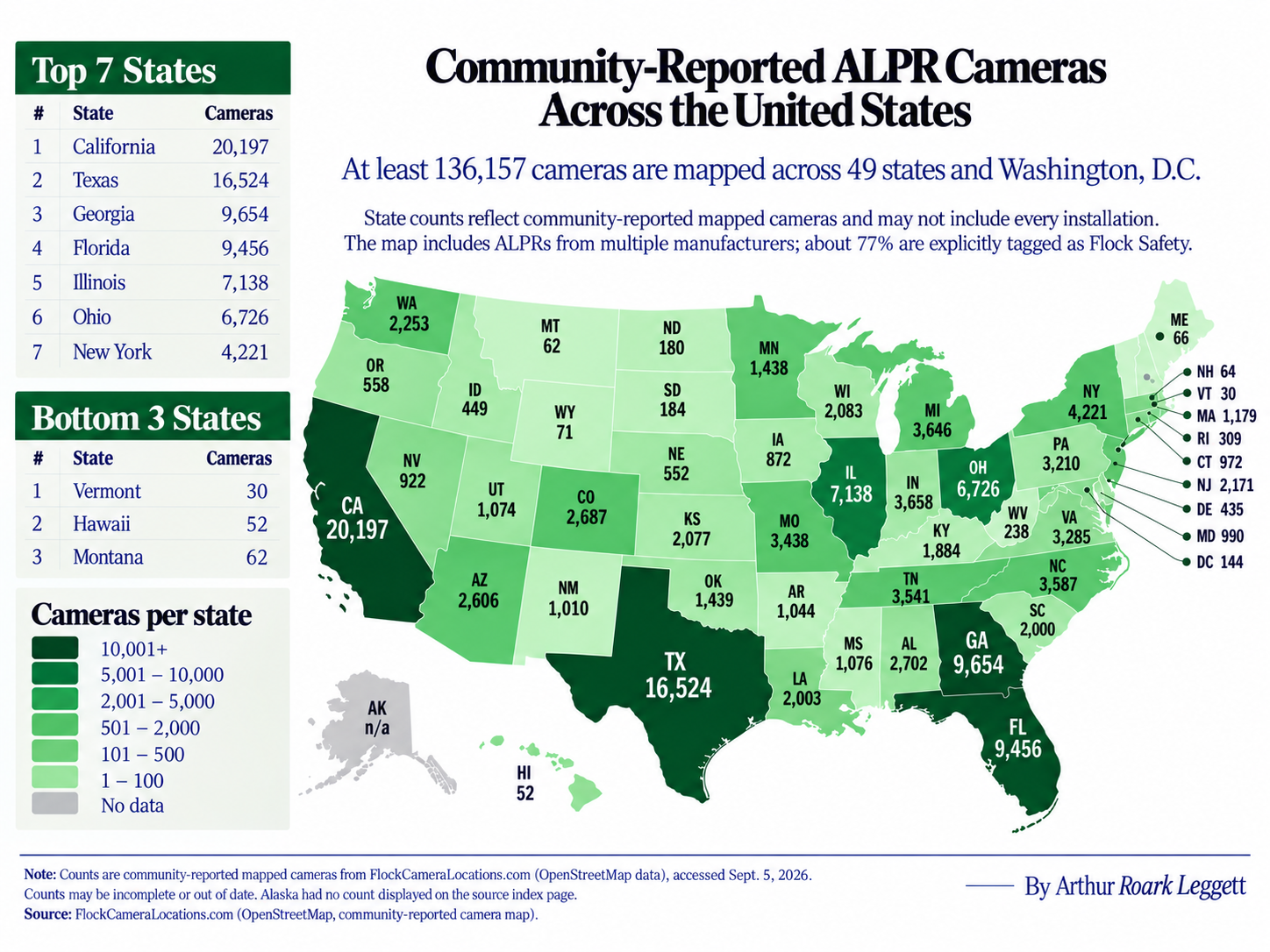
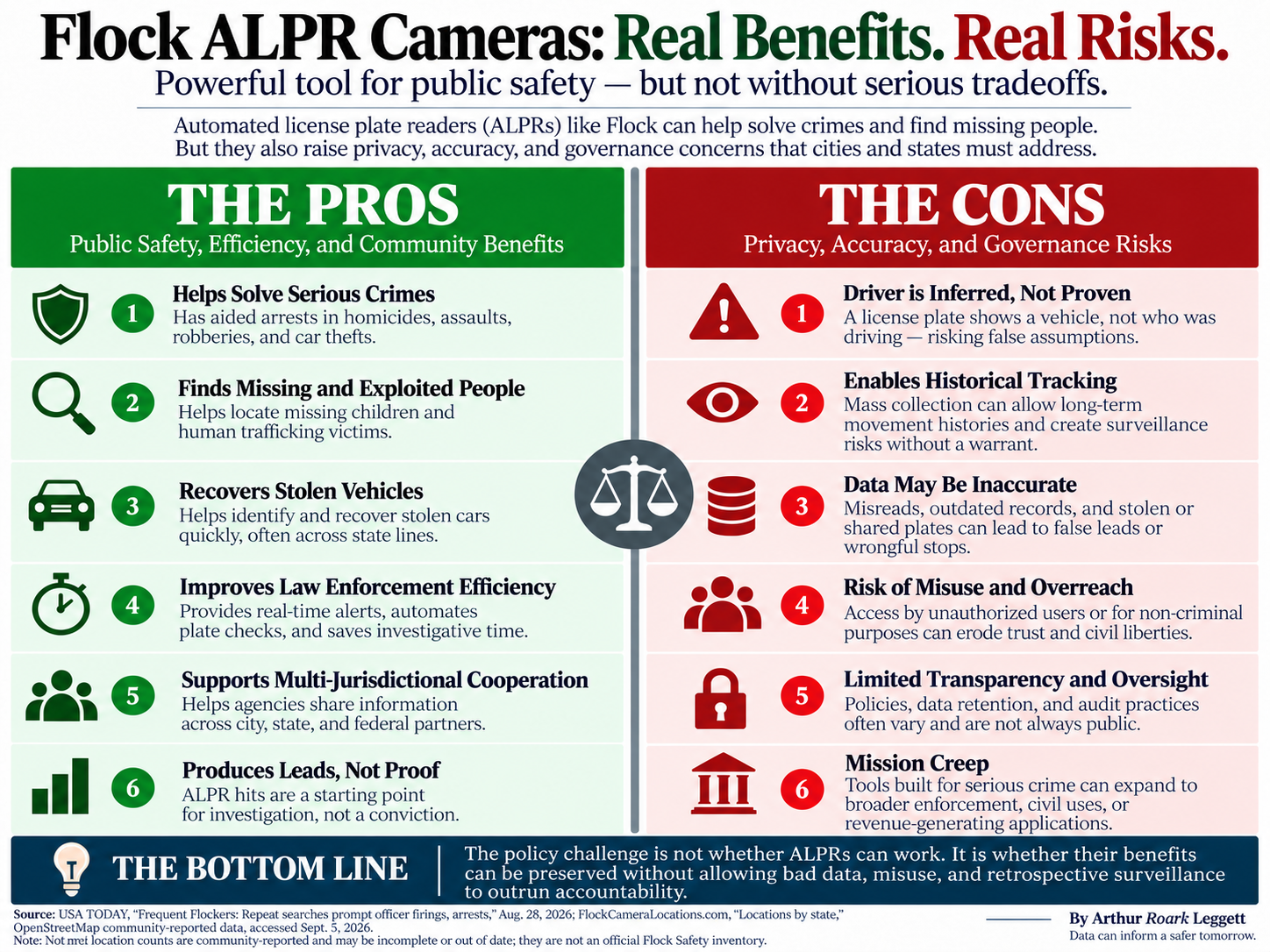
Automated license plate readers (ALPRs) can help recover stolen vehicles, locate missing children and identify vehicles connected to serious crimes. Their visible presence may also deter criminal activity by increasing the likelihood that a vehicle connected to a crime will be identified and traced. Those are legitimate and sometimes lifesaving uses.
But the usefulness of ALPR technology should make us more careful about what it proves—not less.
A license-plate reader identifies a plate associated with a vehicle. It does not identify the driver. It does not establish who is riding in the vehicle, what those people are doing or whether criminal conduct has occurred.
Yet a plate can begin a consequential chain of reasoning:
license plate → registered owner → presumed driver → presumed occupants → presumed conduct → police action
Every arrow represents an inference, and every inference creates another opportunity for error.
The plate is also no longer necessarily the starting point. Modern systems can search by vehicle characteristics, using observable features to narrow the universe of possible vehicles when a plate is unknown, obscured or unreliable:
vehicle characteristics → candidate vehicle → associated person → presumed driver → presumed conduct → police action
That capability helps explain both the usefulness and the danger of the technology. The system may correctly identify a vehicle while the conclusion drawn from that identification is wrong.
Cathy O’Neil’s Weapons of Math Destruction belongs in this discussion because her central warning extends well beyond algorithms themselves: data-driven systems can appear objective while scaling flawed assumptions into consequential harm.
Dirty Data
Consider dirty data.
Brian Hofer rented a Getaround vehicle for a Thanksgiving trip in 2018. The car had previously been reported stolen and later recovered. But according to allegations in a federal court filing, information available to the automated license-plate-reader system still treated the recovered rental car as stolen.
When an ALPR scanned the plate, Contra Costa County sheriff’s deputies stopped the vehicle. Hofer and his brother alleged that deputies surrounded the car, drew weapons, handcuffed them and searched the vehicle before confirming that the rental was legitimate.
The plate had been correctly read. The camera performed as designed. The vehicle had once been stolen. But the information driving the alert no longer reflected the vehicle’s actual status.
The technology did not have to malfunction for the encounter to become dangerous.
That distinction matters because a database tells us what it contains. It does not tell us whether what it contains is still true. And once information moves among police departments, vendors and interconnected databases, correcting an error can become much harder than creating one.
Poisoned Premises
Dirty data are only one vulnerability. Another is deliberately poisoned data.
Someone seeking to harm another person may not need to hack an ALPR system. A malicious actor could instead manipulate the information that causes law enforcement to begin looking for a vehicle:
false report → vehicle association → ALPR hit → presumed conduct → police action
The camera can still perform perfectly. The system can still locate exactly the vehicle it was told to locate. The failure occurred before the search began. The premise was false.
That should force law-enforcement agencies to distinguish between two very different questions: Did the system correctly find the vehicle? And was there a legitimate and sufficiently verified reason to look for that vehicle in the first place?
Authorized Misuse
Then there is authorized misuse. This is not hypothetical.
Haines City police officer Christopher Goodson was arrested in August 2026 after investigators alleged that he searched the Flock license-plate database for his estranged wife’s vehicle 717 times between September 2024 and June 2026. Investigators said the vehicle was not connected to a criminal investigation requiring those searches and alleged that differing law-enforcement justifications were entered for the queries.
That case exposes a different weakness. The officer allegedly did not break into the system. He had permission to use it.
The question therefore cannot stop at who is authorized to search. We must also ask what an authorized user must provide before conducting a search: a documented investigative purpose, a case number, reasonable suspicion, probable cause—and, at some point, a warrant.
When Location Can Become a Weapon
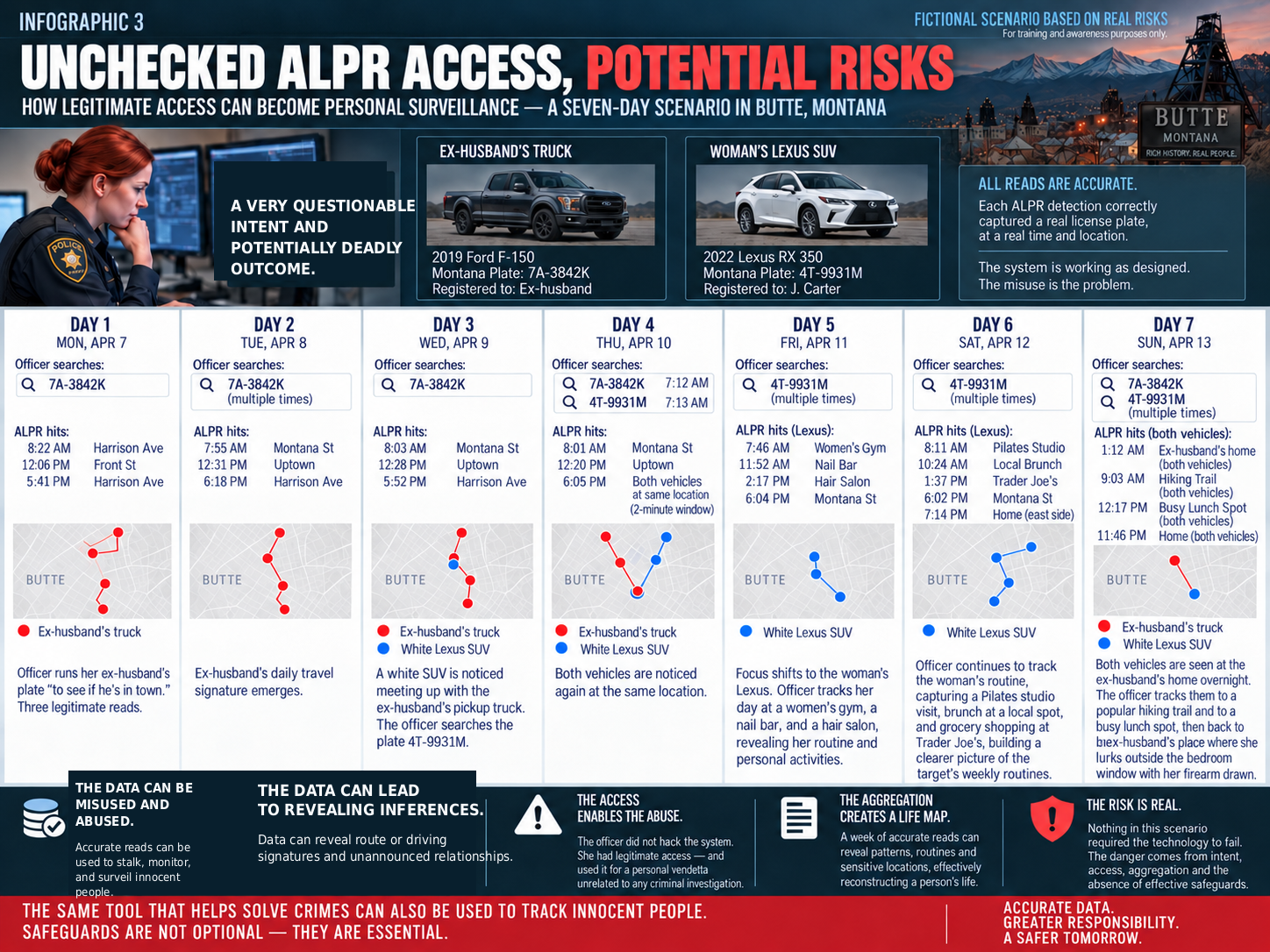
The fictional Butte, Montana, scenario above illustrates how authorized ALPR access could be repurposed for personal surveillance. In the scenario, an officer begins by searching for her ex-husband’s pickup truck. Repeated observations reveal his movements and eventually connect him to a woman driving a white Lexus SUV. The officer then shifts her attention to the woman. Over seven days, approximately 200 searches reveal routines, locations and relationships. What began as the use of an investigative database becomes personal surveillance.
The scenario illustrates a larger danger: the ability to locate and follow another person can become especially dangerous when jealousy, obsession and access to a firearm enter the equation.
That behavioral risk is not unique to ALPR technology. In a 2011 Meridian, Idaho, case later featured on Dateline, Rob Hall went to a Walgreens after learning that his wife, Kandi, was there with her lover, Emmett Corrigan. The confrontation ended with Hall shooting Corrigan dead.
That was not an ALPR case. Its relevance is behavioral. Location knowledge can become especially dangerous when jealousy, obsession and access to a firearm converge.
When Does an Investigative Search Become Surveillance?
The larger policy question emerges when ALPR changes from a real-time investigative tool into a system capable of reconstructing a person’s movements.
A real-time alert that a stolen vehicle just passed a camera is one thing. A historical search revealing where someone routinely goes, when they tend to go there and how those locations connect is something fundamentally different.
Enough observations can reveal patterns. Patterns can reveal routines. Accumulated over time, those routines can reveal the architecture of a person’s life—where they go, whom they meet, what they value and when they may be most vulnerable.
That is the point at which an investigative tool begins to resemble surveillance.
Nashville’s ALPR rules already incorporate part of that distinction. Metro Nashville Police policy requires reasonable suspicion involving specified offenses before authorized employees examine ALPR information collected more than one hour earlier. The department also restricts access, logs and audits searches, and requires two levels of verification of a fixed-camera hit before officers are authorized to conduct a vehicle stop.
Those safeguards matter, but they lead to a larger question: When does an investigative search become surveillance?
The law has not supplied a simple answer for ALPR. In March 2026, the Fifth Circuit held in United States v. Porter that an ALPR alert identifying a vehicle associated with a person wanted on an outstanding arrest warrant, combined with the information available to the officer, supplied reasonable suspicion for the traffic stop that followed.
That was a limited investigative use. Location information becomes constitutionally more complicated as its depth and scope increase.
In June 2026, the Supreme Court held in Chatrie v. United States that government acquisition of Google’s Location History data constituted a Fourth Amendment search because individuals have a reasonable expectation of privacy in their cellphone location information.
The case involved cellphone data, not ALPR, and therefore does not settle the license-plate question. But it reinforces an important principle: technological observations can become qualitatively different when government gains the ability to reconstruct where a person has been.
A single observation tells law enforcement where a vehicle was. A large collection of observations can reveal where a person worships, works, sleeps, seeks medical care, visits family or meets another person.
At sufficient scale, location data stop functioning as isolated observations. They become a detailed record of how a life is lived.
Mission Expansion
That suggests a reasonable hierarchy of safeguards. A real-time ALPR hit should require verification. A retrospective database search should require a documented investigative justification and case number. A search intended to reconstruct a person’s historical movements should require judicial authorization absent a genuine emergency.
That is not hostility toward law enforcement. It is skepticism proportional to power.
Flock itself announced stronger controls in August 2026, including broader case-code requirements, automated misuse detection and mechanisms to suspend access when user behavior meets defined criteria for abnormal activity pending review.
But another risk emerges once the infrastructure is established: mission expansion.
A network originally justified by stolen cars, missing children and violent crime can also be used for parking enforcement, tolls, registrations, fines and other administrative purposes.
That expansion is not theoretical. In 2026, Albany, California, sought ALPR equipment for parking enforcement, including technology capable of identifying vehicles with outstanding parking violations in real time.
Parking enforcement is lawful. That is not the point.
public-safety tool → broader enforcement tool → revenue-producing platform
Once a system can generate revenue, policymakers should ask whether the institution operating it now has a financial incentive to expand its use.
Technology rarely remains confined to its first application. Once the infrastructure exists, additional uses become easier to justify.
So the central question is not merely: Can we do this? It is: What should we permit the system to do?
What should a search require? Who verifies the underlying data? Who audits authorized users? How are errors corrected across police departments, vendors and interconnected systems? When should a judge have to approve a search? And who is accountable when a technically accurate system helps produce a dangerously inaccurate outcome?
ALPRs can be valuable crime-fighting tools. They can help solve crimes, recover stolen vehicles and save lives. None of those benefits requires us to suspend skepticism. Quite the opposite.
The more efficiently technology converts data into law-enforcement action, the more carefully we should examine every inference between the two.
Because the camera can be right.
The plate can be right.
The database can return exactly what it contains.
The machine can operate exactly as designed.
And the conclusion can still be wrong.
Dangerously wrong.
Or deadly.